Freeze Frame: What Elite Players' Unscripted Reactions Tell Us About Real Game Sense
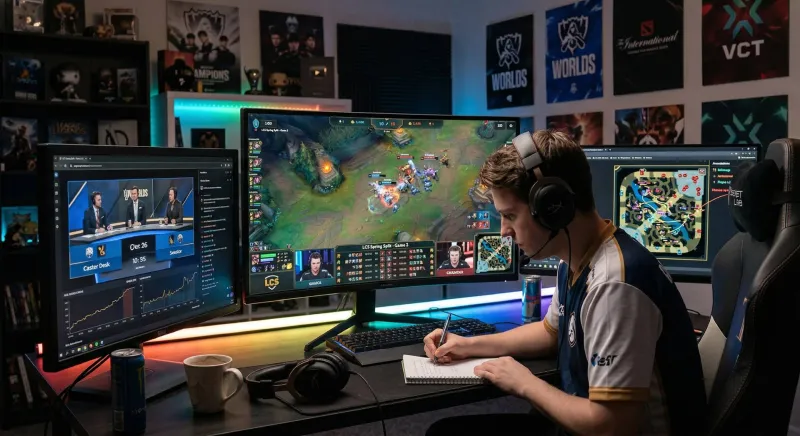
Photo: person watching gaming video on computer screen analyzing gameplay, via cdn.turbosmurfs.gg
Anybody can look good in a highlight reel. Trim the setup, cut before the mistake, add a banger track — suddenly every play looks premeditated and clean. But that's not where the real learning lives.
The clips that actually teach you something? Those are the messy ones. The moments where a teammate does something completely unexpected, or an enemy pulls a move you've never seen, or the map itself turns against you — and a skilled player has to figure it out in real time, with no script.
We've been digging through community clips, VODs, and content creator streams to pull apart those raw reaction moments. What we found says a lot about how elite Brawl Stars players think — and how studying their instincts can sharpen yours.
Why Unscripted Beats Polished Every Time (For Learning)
There's a reason film students study rough cuts and coaches watch practice tape instead of game-day broadcasts. The unpolished version shows you the decision-making, not just the result.
In Brawl Stars, the same principle applies. When you watch a perfectly edited clip of a 1v3 wipe, you're seeing the outcome. You're not seeing the micro-adjustments, the hesitation, the moment the player read something on the map and pivoted. All of that gets cut.
But when you watch a streamer's unedited VOD — especially the moments where something goes sideways — you get to see the actual thinking. The stutter-step when an enemy appears from an unexpected angle. The split-second gadget cancellation. The repositioning that looks almost accidental but absolutely wasn't.
That's game sense made visible. And it's genuinely one of the best study tools available to any player trying to level up.
Breaking Down Three Types of Raw Reaction Moments
Not all unscripted moments are equal. After going through dozens of clips, we've landed on three categories that tend to show the most about a player's instincts.
1. The Teammate Chaos Pivot
This one shows up constantly in team-based modes like Gem Grab and Brawl Ball. A teammate does something completely unexpected — pushes when they should hold, drops gems at the worst possible time, or wanders into a 1v2 they have no business being in — and the skilled player has to recalibrate their entire strategy mid-play.
What separates elite players here isn't that they never get surprised. It's that their adaptation is almost immediate. Watch a high-level player's eyes (metaphorically, in how their brawler moves) the moment a teammate goes rogue. There's usually a brief pause — literally one or two frames — and then a clean pivot. New angle, new priority, new lane.
That pause is the tell. It's the moment they're processing and re-routing. Players with weaker game sense often freeze longer, or worse, commit to the original plan even after it's been invalidated.
2. The Enemy Curveball Read
This is the category that looks most like magic from the outside. An enemy does something completely unexpected — a Spike drops a super from an angle that shouldn't be possible, a Bibi bounces through a gap nobody uses — and the skilled player dodges it like they saw it coming.
They didn't. What they did was pattern-match faster than the average player.
Elite Brawl Stars players have seen enough variations of a situation that when something novel happens, they're not starting from scratch. They're pulling from a mental library of "things that can go wrong here" and their body (or in this case, their thumb) reacts before the conscious brain fully catches up.
This is why raw reaction clips are so valuable for studying. You can actually see where a player's read kicked in — it's usually earlier than you'd expect, and almost never at the moment the threat becomes obvious.
3. The Map Chaos Recovery
Environmental chaos is underrated as a learning tool. Whether it's a bush that got destroyed mid-fight, a wall that a Dynamike just blew open, or a sudden lane change in Heist — map disruptions force players to rebuild their mental model of the space in real time.
Watching how elite players handle this is fascinating. They don't just react to where enemies are. They immediately start projecting where enemies will be given the new map state. That forward-looking adjustment — happening in less than a second — is one of the clearest expressions of high-level game sense you'll find in any clip.
What These Moments Actually Teach You
Okay, so you've found some raw reaction clips. You're watching unedited VODs. What are you actually supposed to take away?
Watch for the pivot point. In every chaotic clip, there's a specific moment when the skilled player's behavior changes. Find it. Pause. Ask yourself: what information did they just receive, and how did it change their decision? Doing this consistently builds your own pattern library.
Count the frames before adaptation. This sounds nerdy, but it's useful. Elite players adapt in roughly 3-5 frames in most situations. If you're watching yourself in a replay and your adaptation took 15-20 frames, that's the gap you're working on.
Pay attention to what they don't do. A lot of game sense is restraint. In teammate chaos pivots especially, the smart play is often to stop doing what you were doing, not to add a new action. Watch for the players who go quiet before they go aggressive — that's usually the tell of a high-IQ decision in progress.
Compare the reaction to the outcome. Sometimes a player adapts perfectly and still loses the moment because of factors outside their control. That's fine, and it's worth noting. The goal isn't to find clips where the reaction led to a win — it's to find clips where the reaction was correct, regardless of result.
Building Your Own Instinct Library
Here's the practical takeaway: if you want better game sense, stop watching montages and start watching mess.
Follow streamers who play ranked without heavy editing. Dig into community clip submissions — the ones that get posted as "lol what do I even do here" rather than "check out this insane play." Those are gold. Watch your own replays, specifically the rounds you lost because something caught you off guard.
The Brawl Stars community produces an enormous amount of raw content every single day. Most of it doesn't get the views that polished highlight reels do, but from a learning standpoint, it's infinitely more valuable.
Game sense isn't something you're born with. It's a library you build — one unscripted, chaotic, completely unpolished clip at a time.
The Snapshot That Actually Matters
At Brawl Snapshots, we love a great highlight as much as anyone. But the most honest snapshot of a player's skill isn't the clean 3v1 wipe with the perfect angle. It's the frame where everything went sideways and they found a way through anyway.
That's the clip worth studying. That's where the real game sense lives.